

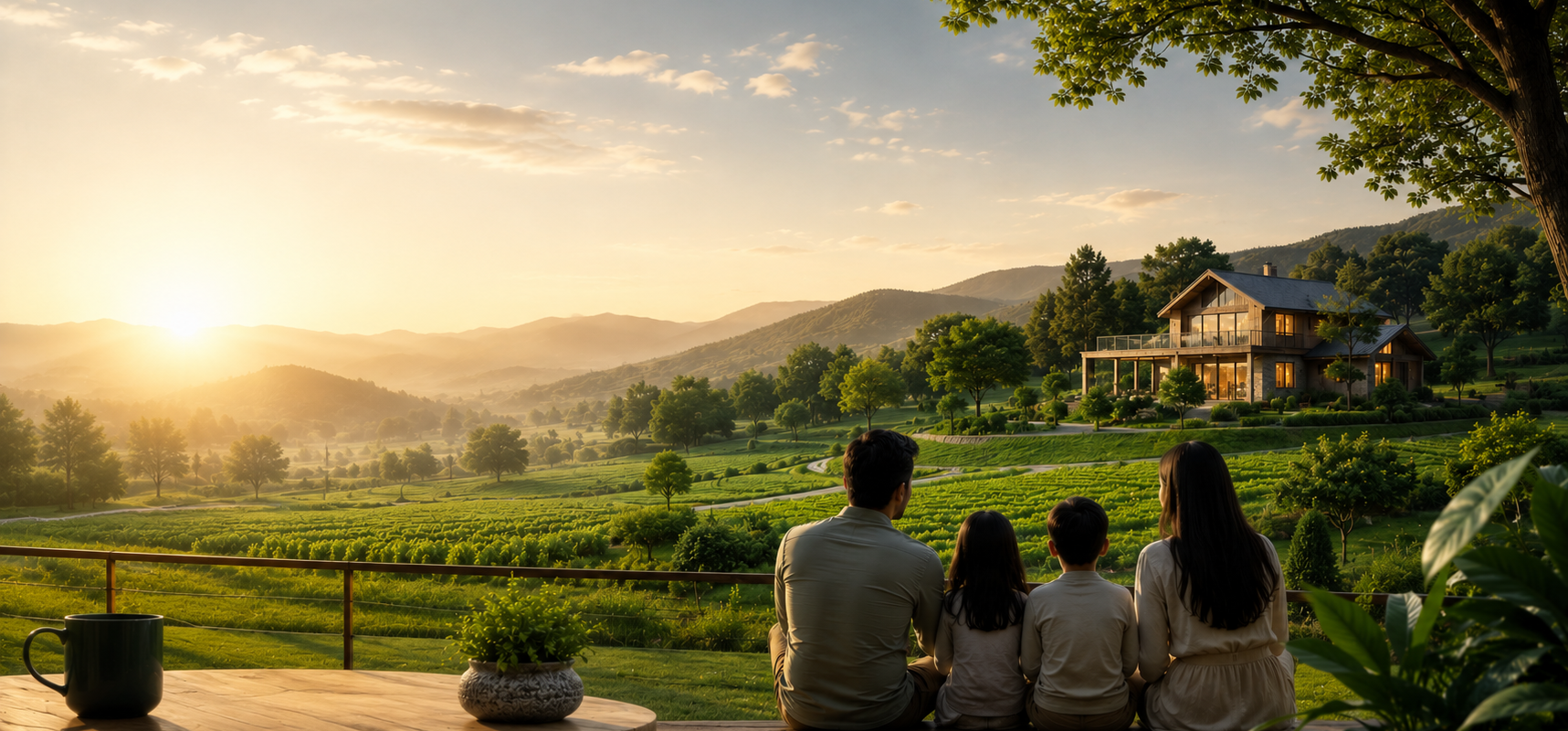
For many the traditional investment options are stocks, gold, apartments or plots. But today, more and more investors are turning to an alternative that offers more than financial ownership managed farmland.
Managed farmland has the appeal of land ownership and the experience of being connected to nature. For a more convenient way to own and enjoy farmland, professional management services are available for plantation, irrigation, maintenance and regular farm activities.
What Is Managed Farmland?
- Managed farmland is agricultural or plantation land that is professionally maintained on behalf of its owners.
Instead of handling everything from the owner’s side, the concept of managed farmland changed everything, like from maintenance to yielding.
- 1. Plantation and tree maintenance
- 2. Irrigation management
- 3. Soil and nutrient management
- 4. Weed and vegetation maintenance
- 5. Farm infrastructure
- 6. Security and regular monitoring
Why Is Managed Farmland Becoming Popular?
Managed farmland offers a combination of investment and lifestyle, which is one of the main reasons people choose it over many other investment options.
The idea of managed farmland is completely different from the typical farmland project.
1. Tangible Asset.
One of the biggest reasons is the combination of investment and lifestyle.
People are looking for assets that are more than just numbers on a screen. Farmland is something tangible, a physical space that owners can visit, spend time in and perhaps share with family, surrounded by green space.
2. Location Can Make a Difference.
When considering farmland as an investment, location deserves careful attention.
- 1. Are roads and infrastructure improving?
- 2. Is the area becoming easier to access?
- 3. Are nearby towns or commercial areas developing?
- 4. Are tourism or residential activities increasing?
- 5. What is the overall growth direction of the region?
3. Professional Management Makes Ownership Easier.
Owning farmland and managing farmland are two different things.
Agriculture requires regular attention, such as watering the plants, providing nutrients, harvesting, and monitoring. All this regular work would be done on the farm, so the managed farmland concept is more flexible in all these aspects.
4. Trees Turn Land Into a Living Asset.
One of the unique aspects of managed farmland is plantation.
Land can change over time as trees grow and the landscape develops. Growth takes time, from a young sapling to a mature tree. As the farm grows, trees can offer shade, promote biodiversity, add to the ecosystem and enhance greenness in the environment.
5. A Different Kind of Weekend
City life is convenient, but it can also be fast-paced.
A managed farm can offer a different kind of weekend — one where the surroundings are quieter, the landscape is greener, and there is room to slow down.
For families, it can also become a place where children experience something that is increasingly difficult to find in urban environments: direct interaction with nature.
7. What Should You Check Before Investing?
Managed farmland can be attractive, but investors should still conduct proper due diligence before purchasing.
Location—please check the location before investing in the managed farmland, as it is well connected to basic needs.
Documentation: Review the documentation thoroughly before making a decision, then take appropriate action.
Water availability: Check the water source. How is the groundwater level, or is there any lake near the river, or are there any Borvels
Land and soil quality : Check if the land is suitable for plantation activity or agricultural activity.
Management : Who will maintain the farm and what exactly is included in the management service?
Accessibility and Development : Check the road accessibility. How is the road access to farms and upcoming development around the project